|
This Early Learning Centre "Sing and Play"
keybord is duophonic, has eight instrument sounds, eight rhythms
and four drumpads that can be switched between playing drum sounds
and starting "rap"-rhythms. The keyboard have a "Melody
Guide" feature, where red LEDs under the white keys shows the
notes to play, for 19 different songs. The songs can also be played
with "one key play" or as demo songs. There is a simple
sequencer that records and plays back what you play. Step increase/decrease
buttons for volume and tempo. On the back side is a mini jack socket
for a microphone.
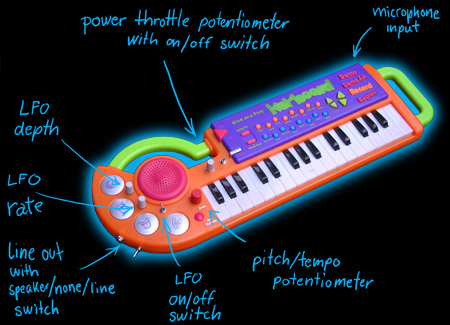
Circuit bends:
Pitch/tempo potentiometer: Regulates the tempo/pitch.
Especially with the organ and violin voices, the ELC is capable
of some fat deep bass sounds, that when tuned even further down
gets overlaid with harsh overtones and turns into a gritty digital
wall-of-noise sound. Using the mandolin voice can give you a technoish
two-note-arpeggiator effect.
As this potentiometer is changing the clockrate of the processor
it also affects the scanning rate of the keyboard, which gets rather
sloppy when the pich/tempo is set low.
LFO: A simple "555" LFO
has been build into the instrument. Through a LED/LDR "DIY
Vactrol" it modulates the pitch and tempo. As the LFO produces
a squarewave, the effect is more like trills than vibrato. There
are two potentiometers to control LFO speed and modulation depth.
An on/off switch enables shifting in the modulation without a fade
in.
Power throttle: This is a potentiometer
that throttles the power going to the processor. When the voltage
gets below at certain limit the processor becomes unstable, which
results in glitching rhytms, random noises, drones and howls or
burst of white noise. Within a narrow range of the potentiometers
full range the intensity of the glitching can be varied, but turning
it just a little further, will make it crash completely, and it
then has to be restet by turning it off and on again. Where the
"sweet point" of the potentiometer is depends on other
settings as well, especially the pitch/tempo pot (it doesn't work
at all when this is set low) but also if there is rhythm or not,
playing through line out or speaker, how many notes are played and
how fresh the batteries are.
Using a dial that is so sensitive and unpredictable in a live performace
is rather difficult, and therefore there is a switch that lets you
dial in a "safe" amount of glitch beforehand, and then
switch between "straight" sound and glitching while performing.
(how well this works depends on not changing the other settings
too much, it is still a rather unstable effect to use).
|